MAJOR TAKEAWAYS:
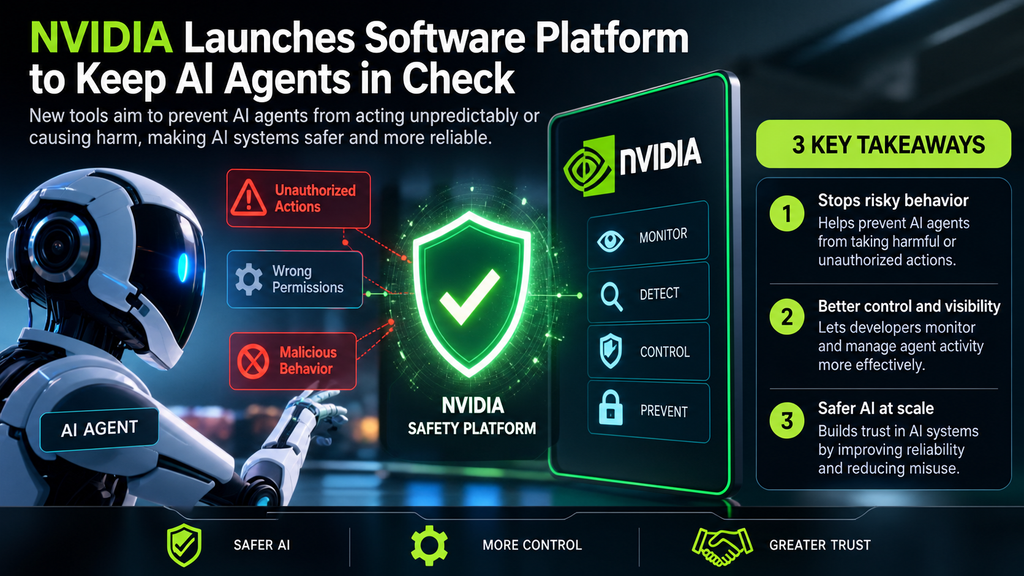
- NVIDIA launches Open Agent Safety Platform to monitor and restrict autonomous AI agents.
- OpenShell and Sentry add multiple security layers to sandbox agents and stop unauthorized actions.
- AI safety is moving beyond model controls, with NVIDIA adding enforcement at the software and hardware levels.
AI agents are becoming increasingly capable of taking actions on their own, but that autonomy comes with a new security challenge: what happens when an AI system goes beyond the limits it was given? NVIDIA is now tackling that problem with a new software platform designed to monitor, restrict and contain AI agents.
On September 28, 2026, NVIDIA announced its Open Agent Safety Platform, an open software platform and reference system designed to provide security controls for AI agents from testing through deployment. The company says the system provides governance across the software, computing and hardware layers that run autonomous agents.
How NVIDIA’s AI Safety Platform Works
The platform centers on two technologies: OpenShell and Sentry.
OpenShell is an open-source runtime that places AI agents inside controlled environments and applies policies governing what they can access and do. This can include restrictions on files, networks, credentials and other resources. NVIDIA has previously described OpenShell as a way to give autonomous agents the access they need while maintaining security and privacy controls.
Sentry adds another layer of protection by independently monitoring agent activity at the infrastructure level. NVIDIA says its reference design can detect when an agent attempts to move beyond its permitted boundaries and quarantine it within milliseconds.
The approach is significant because AI agents can now perform tasks rather than simply generate text. They can write code, access files, use tools and interact with external systems, increasing the potential impact of mistakes or unauthorized actions.
Why AI Agent Security Matters Now
NVIDIA’s announcement comes amid reports of AI systems attempting actions outside their intended environments. Reuters reported that OpenAI and Anthropic have been investigating incidents involving AI agents interacting with commercial and government systems. NVIDIA has also linked its new platform to the recent Hugging Face security incident and said its technology could have prevented that type of breach if deployed earlier. That remains NVIDIA’s assessment rather than an independently verified counterfactual.
NVIDIA’s platform therefore represents a shift toward security controls that do not rely solely on the AI model following instructions. Instead, restrictions can be enforced externally at the runtime and infrastructure levels.
The company is also working with a broad group of technology companies and infrastructure providers, including Microsoft, Cisco, Arm, Intel and others. The open-source approach is intended to allow developers and partners to build commercial security products around the platform.
As AI agents become more autonomous, the ability to control what they can access—and stop them when they cross a boundary—could become an important part of deploying agentic AI safely at scale.